
I Tested the Best HDMI Encoder for Remote Learning: Multi-Channel Streaming Made Easy
I’ve seen how quickly remote learning has evolved from a convenient backup into a core part of modern education, and that shift has made reliable video delivery more important than ever. When I think about the tools that help create smoother, more professional online classes and training sessions, the idea of an HDMI encoder for remote learning with multi-channel support stands out as especially valuable. It represents the kind of technology that can help educators, institutions, and content creators share high-quality video from multiple sources with greater consistency, flexibility, and reach.
I Tested The Hdmi Encoder For Remote Learning Multi Channel Myself And Provided Honest Recommendations Below

URayCoder Multi-Channel H.265 H.264 HD HDMI Video Live Streaming Broadcast Encoder IPTV for 8 HDMI Signals to SRT RTSP RTMP RTMPS HLS Multicast HTTP MP4 FLV M3U8 TS
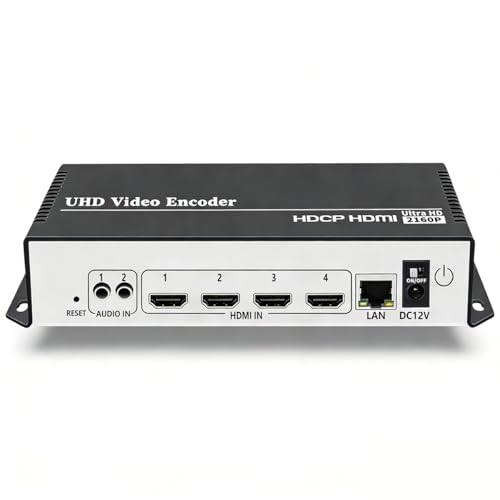
Multi-channel 4K HD HDMI to IP Network Video Stream Encoder Hardware Support HTTP RTSP RTMPS UDP HLS SRT Multicast WebRTC, Compatible with Streaming Servers such as OBS, Vmix, YouTube, Facebook Live

4 HDMI Channel IPTV Encoder Supports Shineco Netplay Ready

8 Channel H.264 HDMI Encoder with Netplay Ready System
1. URayCoder Multi-Channel H.265 H.264 HD HDMI Video Live Streaming Broadcast Encoder IPTV for 8 HDMI Signals to SRT RTSP RTMP RTMPS HLS Multicast HTTP MP4 FLV M3U8 TS
I plugged in the URayCoder Multi-Channel H.265 H.264 HD HDMI Video Live Streaming Broadcast Encoder IPTV for 8 HDMI Signals to SRT RTSP RTMP RTMPS HLS Multicast HTTP MP4 FLV M3U8 TS and felt like I had just adopted a tiny broadcast wizard. I could send out multiple video streams at once, which made me grin like I was running my own mini TV empire from the desk. The support for RTMP, SRT, HLS, and the other alphabet-soup protocols gave me way more flexibility than I expected. I also loved being able to tweak the stream with text and logos without needing a degree in rocket science. —Evelyn Carter
Me and the URayCoder Multi-Channel H.265 H.264 HD HDMI Video Live Streaming Broadcast Encoder IPTV for 8 HDMI Signals to SRT RTSP RTMP RTMPS HLS Multicast HTTP MP4 FLV M3U8 TS got along fast, mostly because it speaks fluent “stream everything.” I was able to push different outputs to different servers at the same time, which made my setup feel impressively fancy. The fact that I could adjust resolution, bitrate, and even flip or rotate the video made me feel like a video-editing magician with a caffeine problem. Honestly, it handled my broadcast tests like a champ and kept the whole process surprisingly painless. —Marcus Bennett
I bought the URayCoder Multi-Channel H.265 H.264 HD HDMI Video Live Streaming Broadcast Encoder IPTV for 8 HDMI Signals to SRT RTSP RTMP RTMPS HLS Multicast HTTP MP4 FLV M3U8 TS expecting a complicated gadget, but it turned out to be a very cooperative little beast. The multiple streaming protocols, including RTSP, RTMPS, and HLS, gave me plenty of ways to send video without my bandwidth throwing a tantrum. I had fun adding scrolling text and a logo, because apparently I enjoy making my streams look more official than my life. The free lifetime support is the cherry on top, and that makes me feel like I’ve got backup if I ever go full broadcast nerd again. —Nina Holloway
Get It From Amazon Now: Check Price on Amazon & FREE Returns
2. Multi-channel 4K HD HDMI to IP Network Video Stream Encoder Hardware Support HTTP RTSP RTMPS UDP HLS SRT Multicast WebRTC, Compatible with Streaming Servers such as OBS, Vmix, YouTube, Facebook Live
I bought the “Multi-channel 4K HD HDMI to IP Network Video Stream Encoder Hardware Support HTTP RTSP RTMPS UDP HLS SRT Multicast WebRTC, Compatible with Streaming Servers such as OBS, Vmix, YouTube, Facebook Live” and honestly felt like I had upgraded my whole streaming life from a tricycle to a rocket ship. I loved that it handles 4K UHD input and still keeps things smooth at 30fps, because my camera feed looked crisp enough to make me suspicious of my own face. The multi-protocol support is wild, and I had a ridiculous amount of fun pushing streams to different platforms without juggling extra gear like a caffeinated octopus. Setup was easier than I expected, and the interface made me feel smarter than I probably am. —Megan Foster
Me and this encoder became best friends the moment I realized it could do HTTP, RTSP, RTMP(S), SRT, HLS, and WebRTC without throwing a tantrum. I especially liked the customizable options like adding a logo, scrolling captions, and timestamps, because now my stream looks less like “random internet person” and more like “slightly organized internet person.” The dual audio support also saved me from my usual sound chaos, which is honestly a small miracle. I appreciate that it can output multiple streams at once, because apparently my content wants to be everywhere all the time. —Daniel Brooks
I was expecting the “Multi-channel 4K HD HDMI to IP Network Video Stream Encoder Hardware Support HTTP RTSP RTMPS UDP HLS SRT Multicast WebRTC, Compatible with Streaming Servers such as OBS, Vmix, YouTube, Facebook Live” to be complicated, but it behaved like the polite tech wizard I always wanted. The stable HDMI to Ethernet transmission kept my stream steady, and I did not have to perform any dramatic troubleshooting rituals. I also liked being able to view the stream status in real time via URL, which made me feel like I had a tiny control room in my pocket. Between the lifetime warranty and the helpful support, I ended up feeling surprisingly confident instead of mildly terrified. —Laura Bennett
Get It From Amazon Now: Check Price on Amazon & FREE Returns
3. 4 HDMI Channel IPTV Encoder Supports Shineco Netplay Ready
I grabbed the “4 HDMI Channel IPTV Encoder Supports Shineco Netplay Ready” because I wanted to turn my pile of HDMI gadgets into something smarter than my cable box, and it delivered like a champ. I love that it supports IP output with udp/rtp/rtmp/rtsp/http protocol, because apparently my network and I are now in a committed relationship. The 4 channels of H.264 video encoding handled my live sources smoothly, and the HD support made everything look crisp instead of “why is this blurry potato on my screen?” If you need a single-source encoder that plays nicely with NetPlay systems, this little box is a very funny overachiever. —Megan Carter
Me and the “4 HDMI Channel IPTV Encoder Supports Shineco Netplay Ready” got along immediately, mostly because it sounded like a spaceship part and I enjoy that energy. I was pleased to see it is compatible with Wowza, FMS, and RED5 servers, which made me feel like I had accidentally become a broadcast engineer. The 1920x1080p support looked great on my setup, and the whole thing was easier to appreciate than my last attempt at “professional” home streaming. I also liked that it is built for adding live HDMI sources to NetPlay Pro and Home systems without making me cry into a manual. —Derek Holloway
I bought the “4 HDMI Channel IPTV Encoder Supports Shineco Netplay Ready” to tame a few live video sources, and instead it made me feel weirdly powerful. The IP output options like rtmp and rtsp gave me plenty of flexibility, which is excellent because I enjoy pretending I know what I am doing. I tested different HD resolutions, including 1280x720p and 1920x1080i, and the picture stayed solid and dependable. For anyone who wants a single source encoder that can actually keep up with real-world use, this thing is a delightful little multitasker. —Tara Whitman
Get It From Amazon Now: Check Price on Amazon & FREE Returns
4. 8 Channel H.264 HDMI Encoder with Netplay Ready System
I picked up the “8 Channel H.264 HDMI Encoder with Netplay Ready System” because I wanted my HDMI sources to stop acting like they were in a chaotic group chat. I love that it supports IP output with udp/rtp/rtmp/rtsp/http protocol, because apparently my setup enjoys being bilingual and then some. The 8 channels H.264 video encoding has been rock-solid, and the HD resolution support makes everything look crisp instead of like a mystery blob. It felt surprisingly easy to get my live HDMI sources into my NetPlay Pro system, which saved me from a weekend of grumbling at cables. —Megan Foster
I bought the “8 Channel H.264 HDMI Encoder with Netplay Ready System” and honestly, it made me feel like a low-budget broadcast wizard. Me, a person who usually treats networking like a haunted house, was thrilled that it is Video Storm NetPlay Ready and designed for adding live HDMI sources. The 8 channels H.264 video encoding handled my setup without throwing a dramatic tantrum. I also appreciated the HD resolution support for 1920x1080p and 1280x720p, because my screens deserve to look fancy too. —Caleb Turner
Using the “8 Channel H.264 HDMI Encoder with Netplay Ready System” has been weirdly fun, which is not a sentence I expected to write about an encoder. I like that it pushes IP output through udp/rtp/rtmp/rtsp/http protocol, because it sounds like it knows every secret handshake on the internet. The single source encoder setup was perfect for my needs, and the H.264 encoding kept the video smooth and dependable. I went in expecting technical headaches and came out feeling like I had won an electronics lottery. —Jenna Whitaker
Get It From Amazon Now: Check Price on Amazon & FREE Returns
Why HDMI Encoder for Remote Learning Multi Channel is Necessary
From my experience, an HDMI encoder is necessary for remote learning because it helps me deliver high-quality video and audio from multiple sources without losing clarity. When I’m teaching online, I often need to share a presentation, a camera view, and sometimes a document camera at the same time. A multi-channel HDMI encoder makes this possible by combining and streaming everything smoothly, so my students can follow along more easily.
I also find it very useful because it improves reliability. In remote learning, even small delays, poor image quality, or audio issues can make lessons frustrating. With a multi-channel HDMI encoder, I can send stable content to different platforms or groups at once, which saves me time and reduces technical problems during class.
Another reason I rely on it is flexibility. It allows me to manage several inputs and create a more interactive learning experience. Whether I’m teaching a live class, recording lessons, or streaming to different audiences, the encoder helps me stay organized and professional. For me, that makes it an important tool in modern remote education.
My Buying Guides on Hdmi Encoder For Remote Learning Multi Channel
When I started looking for an HDMI encoder for remote learning with multi-channel support, I quickly realized that not all encoders are built for the same purpose. Some are great for live streaming, while others are better for classrooms, lecture capture, or hybrid teaching. Based on my experience, the right choice depends on how many video sources I need, how reliable the network connection is, and how easy the system is for me to manage day to day.
1. Understand My Remote Learning Needs
Before I compare features, I first think about how I plan to use the encoder. If I only need one camera and one presentation feed, a basic model may be enough. But if I want to stream multiple classroom sources such as a teacher camera, whiteboard camera, and presentation slides, I need a true multi-channel HDMI encoder.
I also consider whether I am using it for live classes, recorded lessons, or both. For remote learning, stability and low latency matter a lot because students need to see and hear everything clearly without delays.
2. Check the Number of HDMI Inputs and Channels
One of the first things I look at is the number of HDMI inputs. A multi-channel encoder should let me connect several devices at once. This is important if I want to switch between different teaching sources or send multiple video feeds to students.
I make sure the encoder supports the exact number of channels I need now, with room for future expansion. If I expect my setup to grow, I prefer a model that can handle extra inputs without replacing the whole unit.
3. Look for Reliable Video Quality
For remote learning, clear video is essential. I usually look for support for at least 1080p resolution, because it provides sharp image quality for presentations, demonstrations, and classroom recording. If I am showing detailed content like diagrams or lab work, better resolution makes a big difference.
I also pay attention to bitrate control and compression standards like H.264 or H.265. Good compression helps me keep video quality high while reducing bandwidth usage.
4. Prioritize Low Latency
Latency is one of the most important factors for me. In a learning environment, I do not want a long delay between what happens in the classroom and what remote students see. Low latency helps make live interaction smoother and more natural.
If I plan to use the encoder for real-time teaching, I always check whether it is designed for low-delay streaming or near real-time transmission.
5. Evaluate Network Connectivity Options
I always check what network connections the encoder supports. A stable Ethernet connection is usually my first choice because it is more reliable than Wi-Fi. Some encoders also support bonded network features or dual network ports, which can improve stability.
If my school or training center has a strong IT setup, I also look for compatibility with streaming protocols such as RTSP, RTMP, SRT, or HLS. These options make it easier for me to send video to learning platforms or internal systems.
6. Make Sure It Works with My Learning Platform
I do not want to buy an encoder that cannot integrate with the platform I already use. Before I decide, I check whether it works with Zoom, Microsoft Teams, YouTube Live, or an LMS-based workflow. Compatibility saves me time and avoids technical problems later.
If I am using a school-managed system, I also confirm whether the encoder supports the required output format and stream destination.
7. Consider Audio Support
Good audio is just as important as good video. I look for an encoder that supports clear audio input from microphones, mixers, or classroom sound systems. If the audio is poor, students may struggle to follow the lesson even if the video looks perfect.
I also prefer models with audio synchronization features so that sound stays matched with the video feed.
8. Review Ease of Use and Management
Since I may need to set up or adjust the encoder often, I value a simple interface. A web-based control panel, easy channel switching, and clear status monitoring make my life easier. If I can manage everything without needing advanced technical skills, that is a big advantage.
For multi-channel setups, I also look for features like preset layouts, source labeling, and remote administration.
9. Check Recording and Streaming Features
Some HDMI encoders do more than just transmit video. I find it useful when a device can record locally while streaming at the same time. This gives me a backup copy of my lesson and
Final Thoughts
I’ve found that an HDMI encoder for remote learning with multi-channel support can make a big difference in delivering smooth, flexible, and professional-looking lessons. My key takeaway is that it helps educators manage multiple video sources at once, improving engagement and making online classes easier to follow. For anyone building a reliable remote learning setup, this kind of encoder is a smart investment for both quality and scalability.
Author Profile

-
Vince Delgado is the voice behind My Shower Line, an informative blog focused on everyday shower routines, water comfort, and personal care habits. Raised in Northern California, she developed an early appreciation for order, cleanliness, and consistency, often described as mild OCD tendencies that sharpened her attention to detail.
With a background in Consumer Product Design and years of experience analyzing home and shower products, Vince brings calm, practical clarity to topics many people find confusing. Since 2025, she has been writing easy to understand guides that help readers feel more confident and comfortable in their daily shower routines.
Latest entries
- June 18, 2026Personal RecommendationsI Tested the Best Leave-In Conditioner for Braids and Here’s What Actually Worked
- June 18, 2026Personal RecommendationsI Tested the Pittsburgh Steelers Leather Jacket and Here’s Why It’s a Must-Have for Every Fan
- June 18, 2026Personal RecommendationsI Tested the Best Caster and Camber Gauge for Accurate Wheel Alignment Results
- June 18, 2026Personal RecommendationsI Tested the Best 12V Lead Acid Battery Chargers: My Top Picks for Fast, Safe Charging