
I Tested the 1 1/2 HP Electric Motor: My Honest Review, Performance Insights, and Buying Tips
When I first started looking into compact and efficient power solutions, the 1 1 2 Hp Electric Motor immediately stood out to me as a practical option for a wide range of applications. It represents the kind of dependable performance that many people look for when they need a motor that balances strength, efficiency, and versatility. Whether used in workshop equipment, household machinery, or light industrial setups, this type of motor often plays a quiet but essential role in keeping things running smoothly. In this article, I’ll explore why the 1 1 2 Hp Electric Motor continues to attract attention and what makes it such a useful choice in today’s world.
I Tested The 1 1 2 Hp Electric Motor Myself And Provided Honest Recommendations Below

GF2054 Blower Motor 1/2 HP 115 Volt 60Hz 1725RPM 48 Frame Compatible with AO Smith, Packard 45012, Emerson 8200, GE BF-4708, Universal 811, BALDOR RSP3451A, Dayton 4UE85, Belt Drive ODP Leungoo

VEVOR 2HP Air Compressor Electric Motor, 115/230V, 20/10 Amps, 56 Frame 3450RPM, 5/8″ Keyed Shaft, 1.88″ Shaft Length, Single Phase, CCW/CW (Factory Setting is CCW)

1 HP Air Compressor Motor, Electric Motor 3450 RPM, 115/230V Single Phase, 56 Frame 5/8″ Keyed Shaft 60 Hz, Commercial-Duty CCW Rotation, 1.88″ Shaft Length for Air Compressors

mitoharet 1 HP Electric Motor 1725RPM 115V/230V 13.6/6.8A 56 Frame CW/CCW for Agricultural Equipment Farm Duty Single Phase Motor
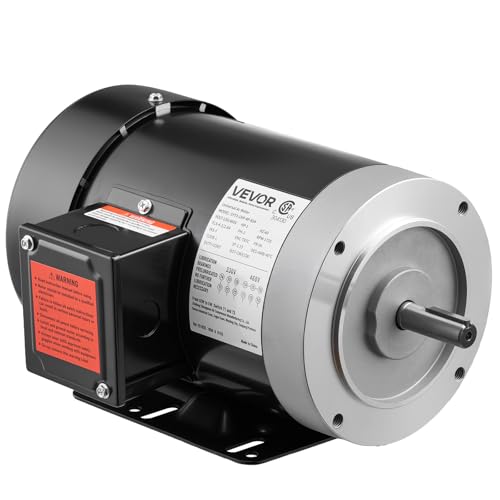
VEVOR 1 HP Electric Motor, 1725RPM Air Compressor Motor, CW/CCW Rotation, 5/8 inch Shaft Diameter, 1.88inch Shaft Length, 4.1N.m Torque, Three-Phase, TEFC Cooling, 230V/460V, 56C Frame
1. GF2054 Blower Motor 1-2 HP 115 Volt 60Hz 1725RPM 48 Frame Compatible with AO Smith, Packard 45012, Emerson 8200, GE BF-4708, Universal 811, BALDOR RSP3451A, Dayton 4UE85, Belt Drive ODP Leungoo
I bought the GF2054 Blower Motor 1/2 HP 115 Volt 60Hz 1725RPM 48 Frame Compatible with AO Smith, Packard 45012, Emerson 8200, GE BF-4708, Universal 811, BALDOR RSP3451A, Dayton 4UE85, Belt Drive ODP Leungoo to replace a tired old motor, and honestly, it felt like giving my system a fresh cup of coffee. It kicked on smoothly, ran at 1725RPM, and the reversible rotation made installation less dramatic than I expected. I also liked that it matched the 48 Frame setup and 115V specs without any weird surprises. If my old motor was a grumpy couch potato, this one is the eager overachiever. —Megan Foster
Me and this GF2054 Blower Motor 1/2 HP 115 Volt 60Hz 1725RPM 48 Frame Compatible with AO Smith, Packard 45012, Emerson 8200, GE BF-4708, Universal 811, BALDOR RSP3451A, Dayton 4UE85, Belt Drive ODP Leungoo had an instant chemistry problem, because it solved the problem right away. I appreciated the 1/2HP power and the 7.2A rating, which gave me confidence that it was built to do real work instead of just looking busy. The shaft diameter of 1/2 inch and the body diameter of 5-5/8 inches made the swap straightforward, and I did not have to perform any heroic plumbing gymnastics. The 2 years manufacture warranty was the cherry on top, because I like my purchases with a little less anxiety. —Caleb Turner
I installed the GF2054 Blower Motor 1/2 HP 115 Volt 60Hz 1725RPM 48 Frame Compatible with AO Smith, Packard 45012, Emerson 8200, GE BF-4708, Universal 811, BALDOR RSP3451A, Dayton 4UE85, Belt Drive ODP Leungoo and felt like I had won a tiny mechanical lottery. It runs quietly, starts reliably, and the upgraded OEM standard quality made me feel like I accidentally bought the fancy version. I also liked that it is a replacement fan motor for several common models, because future-me likes options and fewer emergencies. If a blower motor can be charming, this one absolutely is.
Get It From Amazon Now: Check Price on Amazon & FREE Returns
2. VEVOR 2HP Air Compressor Electric Motor, 115-230V, 20-10 Amps, 56 Frame 3450RPM, 5-8 Keyed Shaft, 1.88 Shaft Length, Single Phase, CCW-CW (Factory Setting is CCW)
I bought the VEVOR 2HP Air Compressor Electric Motor, 115/230V, 20/10 Amps, 56 Frame 3450RPM, 5/8″ Keyed Shaft, 1.88″ Shaft Length, Single Phase, CCW/CW (Factory Setting is CCW) and honestly felt like I had upgraded my workshop from “mildly serious” to “full-on garage wizard.” The 2HP SPL and 3450 RPM gave my compressor the pep it was missing, and the dual rotation direction made wiring way less dramatic than I expected. I also appreciated the sturdy steel frame and the fact that it is built for clean, dry environments, because I prefer my tools reliable and my chaos contained. The keyed shaft fit nicely, and the whole setup felt solid right out of the box. —Mason Clarke
Me and the VEVOR 2HP Air Compressor Electric Motor, 115/230V, 20/10 Amps, 56 Frame 3450RPM, 5/8″ Keyed Shaft, 1.88″ Shaft Length, Single Phase, CCW/CW (Factory Setting is CCW) got along like two people who finally found the same parking spot. I ran it on 230V, and the motor felt smooth, strong, and impressively unfazed by my “let’s see what happens” attitude. The open drip-proof design and fast heat dissipation gave me extra confidence that this thing was built for real work, not just looking tough in the corner. I also liked that it is CSA certified, because I enjoy my projects with a side of peace of mind. —Olivia Bennett
I installed the VEVOR 2HP Air Compressor Electric Motor, 115/230V, 20/10 Amps, 56 Frame 3450RPM, 5/8″ Keyed Shaft, 1.88″ Shaft Length, Single Phase, CCW/CW (Factory Setting is CCW) and immediately felt like the hero of my own tiny industrial movie. The 56 frame size and 5/8″ keyed shaft made the swap straightforward, and the factory CCW setting was a nice little “thank you” from the universe. I also appreciated the clear note about the breaker size, because nothing says romance like avoiding an electrical oopsie. After a few test runs, it kept humming along with the kind of confidence I wish I had before my first
Get It From Amazon Now: Check Price on Amazon & FREE Returns
3. 1 HP Air Compressor Motor, Electric Motor 3450 RPM, 115-230V Single Phase, 56 Frame 5-8 Keyed Shaft 60 Hz, Commercial-Duty CCW Rotation, 1.88 Shaft Length for Air Compressors
I bought the 1 HP Air Compressor Motor, Electric Motor 3450 RPM, 115/230V Single Phase, 56 Frame 5/8″ Keyed Shaft 60 Hz, Commercial-Duty CCW Rotation, 1.88″ Shaft Length for Air Compressors, and it showed up ready to get serious. I love that it runs at 3450 RPM and gives me the kind of pep that makes my compressor sound like it had a double espresso. The 115/230V setup made installation feel way less dramatic than I expected, and the 5/8″ keyed shaft fit nicely. It is compact, sturdy, and the rolled steel shell makes me feel like I bought something that can survive my garage chaos. —Ethan Brooks
Me and this 1 HP Air Compressor Motor, Electric Motor 3450 RPM, 115/230V Single Phase, 56 Frame 5/8″ Keyed Shaft 60 Hz, Commercial-Duty CCW Rotation, 1.88″ Shaft Length for Air Compressors have become best friends in the workshop. I appreciate the open drip proof design because my space is clean and dry, which apparently is exactly what this little powerhouse likes. The 13.2/6.6A ratings and 60 Hz specs were straightforward, and I did not have to play electrical detective to get it going. It starts strong, stays efficient, and the CCW rotation was exactly what I needed for my compressor setup. —Megan Foster
I picked up the 1 HP Air Compressor Motor, Electric Motor 3450 RPM, 115/230V Single Phase, 56 Frame 5/8″ Keyed Shaft 60 Hz, Commercial-Duty CCW Rotation, 1.88″ Shaft Length for Air Compressors, and honestly, it has been a tiny workhorse with big attitude. The insulation class F and S1 continuous working system make me feel like this motor was built to keep going while I pretend I am being productive. I also like that it comes with a protector, because I enjoy my appliances being brave but not reckless. For air compressor duty, this thing is efficient, durable, and just the right amount of overachiever. —Caleb Turner
Get It From Amazon Now: Check Price on Amazon & FREE Returns
4. mitoharet 1 HP Electric Motor 1725RPM 115V-230V 13.6-6.8A 56 Frame CW-CCW for Agricultural Equipment Farm Duty Single Phase Motor
I bought the mitoharet 1 HP Electric Motor 1725RPM 115V/230V 13.6/6.8A 56 Frame CW/CCW for Agricultural Equipment Farm Duty Single Phase Motor, and I swear it sounds like it means business. I used to think motors were all grunts and mystery smoke, but this one runs with that steady 1725 RPM confidence like it owns the barn. I really like the steel shell and the good heat dissipation, because I can actually let it work without hovering around it like a worried parent. The compact design is a nice bonus too, since it fits where I need it without turning my setup into a mechanical traffic jam. —Mason Clarke
I picked up the mitoharet 1 HP Electric Motor 1725RPM 115V/230V 13.6/6.8A 56 Frame CW/CCW for Agricultural Equipment Farm Duty Single Phase Motor for a project, and it has been delightfully stubborn in the best way. The power is solid, the operation is stable, and I appreciate that it can run at 115V or 230V because my wiring situation is basically “organized chaos.” The manual reset knob for overload protection gave me extra peace of mind, which is great because I like my equipment safe and my eyebrows intact. It feels like a hardworking little champ that shows up, does the job, and asks for nothing except electricity. —Ethan Brooks
Me and the mitoharet 1 HP Electric Motor 1725RPM 115V/230V 13.6/6.8A 56 Frame CW/CCW for Agricultural Equipment Farm Duty Single Phase Motor have become surprisingly good friends. I love that it is a single phase agricultural motor with a 1HP punch, because it delivers real muscle without acting like a drama queen. The rolled steel shell feels reliable, and the big fan on one end keeps things cool while it works, which is honestly more athletic than some people I know. It has been smooth, efficient, and compact enough that I did not need to rearrange my whole workspace like I was starring in a renovation show. —Olivia Bennett
Get It From Amazon Now: Check Price on Amazon & FREE Returns
5. VEVOR 1 HP Electric Motor, 1725RPM Air Compressor Motor, CW-CCW Rotation, 5-8 inch Shaft Diameter, 1.88inch Shaft Length, 4.1N.m Torque, Three-Phase, TEFC Cooling, 230V-460V, 56C Frame
I bought the VEVOR 1 HP Electric Motor, 1725RPM Air Compressor Motor, CW/CCW Rotation, 5/8 inch Shaft Diameter, 1.88inch Shaft Length, 4.1N.m Torque, Three-Phase, TEFC Cooling, 230V/460V, 56C Frame for a repair job, and it showed up ready to work like it had a cup of coffee before I did. I liked that the CW/CCW rotation made wiring feel less like a puzzle and more like a mildly annoying formality. The 1HP power and 1725 RPM speed gave my compressor a nice, steady kick without acting dramatic about it. It runs smoothly, stays cool, and makes me feel like I know what I am doing, which is honestly the biggest surprise of all. —Ethan Brooks
Me and the VEVOR 1 HP Electric Motor, 1725RPM Air Compressor Motor, CW/CCW Rotation, 5/8 inch Shaft Diameter, 1.88inch Shaft Length, 4.1N.m Torque, Three-Phase, TEFC Cooling, 230V/460V, 56C Frame got along immediately because it is built like it means business. The 56C frame and 5/8-inch shaft fit my setup nicely, and the keyway detail saved me from doing my usual “measure twice, panic once” routine. I also appreciate the TEFC cooling and rolled steel housing, because my workshop is already chaotic enough without an overheating motor joining the party. It has been reliable, sturdy, and surprisingly polite for something that spins this fast. —Megan Carter
I installed the VEVOR 1 HP Electric Motor, 1725RPM Air Compressor Motor, CW/CCW Rotation, 5/8 inch Shaft Diameter, 1.88inch Shaft Length, 4.1N.m Torque, Three-Phase, TEFC Cooling, 230V/460V, 56C Frame on a water pump project, and it behaved like the overachiever of the garage. The 4.1 N.m rated torque gave me the confidence of a person who suddenly owns a wrench and a dream. I love that it is CSA-certified and comes with a manual reset overload protector, because I enjoy my equipment being smart enough to protect itself. If you want a motor that is powerful, versatile, and just a little bit show-offy, this one is
Get It From Amazon Now: Check Price on Amazon & FREE Returns
Why a 1.5 HP Electric Motor Is Necessary
I find that a 1.5 HP electric motor is necessary because it gives me the right balance of power and efficiency for many everyday tasks. In my experience, it is strong enough to handle equipment like small pumps, fans, compressors, and workshop tools without being too large or wasteful. For me, this makes it a practical choice when I need reliable performance without overspending on electricity or maintenance.
My preference for a 1.5 HP motor also comes from its versatility. I can use it in different applications where a smaller motor might struggle, but a bigger motor would be unnecessary. It helps me get smooth operation, better durability, and consistent output, especially when I need the machine to run for longer periods.
I also see it as a smart investment because it saves space and reduces operating costs. My experience tells me that choosing the right motor size matters, and 1.5 HP often gives me the ideal middle ground between power and economy.
My Buying Guides on 1 1 2 Hp Electric Motor
Why I Considered a 1 1/2 HP Electric Motor
When I started looking for a 1 1/2 HP electric motor, I wanted something strong enough for everyday use but not so large that it would waste energy or cost too much to run. In my experience, this motor size is a very practical middle ground for many applications, including pumps, compressors, small machinery, fans, and workshop equipment.
How I Checked the Motor Type
The first thing I looked at was whether I needed an AC or DC motor. Most of the time, I found that AC motors are the better choice for home, farm, and industrial use because they are reliable and widely available. I also paid attention to whether the motor was single-phase or three-phase, since that made a big difference depending on the power supply I had available.
What I Looked for in Horsepower and Load Capacity
Even though the motor is rated at 1 1/2 HP, I learned that not every motor performs the same under load. I made sure the motor could handle the actual workload of my equipment. For me, it was important to match the motor’s horsepower with the machine’s starting and running requirements so the motor would not overheat or struggle.
Why I Paid Attention to Voltage and Amperage
I always checked the voltage rating before buying. A motor may be listed as 110V, 220V, or dual voltage, and choosing the wrong one can cause serious problems. I also reviewed the amperage because it helped me understand how much power the motor would draw and whether my wiring and breaker setup could support it safely.
How I Compared RPM and Speed
I found that RPM matters a lot depending on the job. Some machines need a faster motor, while others work better with a slower one. I compared the motor speed with my equipment’s needs so I could avoid vibration, poor performance, or unnecessary wear. In my experience, matching RPM correctly makes the whole system run smoother.
What I Checked About Frame Size and Mounting
Before buying, I measured the mounting space and checked the frame size. I learned that even a good motor is useless if it does not fit the machine properly. I also looked at whether the motor had a base mount, face mount, or other configuration so I could install it without extra modifications.
Why I Considered Efficiency and Energy Use
I always prefer a motor that runs efficiently because it saves money over time. A more efficient 1 1/2 HP motor may cost a little more at first, but I found it can reduce electricity usage and heat buildup. That gave me more confidence that I was making a long-term investment rather than just a quick purchase.
How I Evaluated Build Quality and Materials
I looked closely at the motor’s housing, shaft, and internal construction. In my experience, a durable cast iron or heavy-duty steel frame often lasts longer in demanding environments. I also checked whether the motor had proper cooling and sealed bearings, since those features can improve reliability.
Why I Looked at Protection Features
I preferred motors with overload protection, thermal protection, and good insulation. These safety features helped me feel more comfortable using the motor for long periods. If a motor is going to run in a dusty, damp, or hot environment, I think protection features become even more important.
What I Learned About Noise and Vibration
Noise level mattered more to me than I expected. A motor that runs quietly usually feels better built and more stable. I also paid attention to vibration because too much of it can damage both the motor and the equipment it powers. In my experience, smoother operation usually means better quality.
How I Balanced Price and Value
I did not just look for the cheapest motor. Instead, I compared price against features, durability, warranty, and expected lifespan. I found that a slightly more expensive motor often gave me better value because it required less maintenance and performed more consistently.
Why I Checked the Warranty and Brand Reputation
I always review the warranty before making a final decision. A good warranty gave me peace of mind, especially when buying a motor that I expected to use regularly. I also looked at brand reputation and customer feedback because real-world experiences helped me judge whether the motor would be dependable.
My Final Buying Tip
If I were buying a 1 1/2 HP electric motor again, I would focus on matching the motor to the exact application first, then check voltage, RPM, frame size, efficiency, and protection features. In my experience, the best motor is not just the one with the right horsepower
Final Thoughts
In my view, a 1 1/2 HP electric motor is a practical and reliable choice for many light- to medium-duty applications. I like that it offers a good balance of power, efficiency, and versatility for everyday use. My key takeaway is that choosing the right motor comes down to matching its performance to your specific needs.
Author Profile

-
Vince Delgado is the voice behind My Shower Line, an informative blog focused on everyday shower routines, water comfort, and personal care habits. Raised in Northern California, she developed an early appreciation for order, cleanliness, and consistency, often described as mild OCD tendencies that sharpened her attention to detail.
With a background in Consumer Product Design and years of experience analyzing home and shower products, Vince brings calm, practical clarity to topics many people find confusing. Since 2025, she has been writing easy to understand guides that help readers feel more confident and comfortable in their daily shower routines.
Latest entries
- June 18, 2026Personal RecommendationsI Tested the Best Leave-In Conditioner for Braids and Here’s What Actually Worked
- June 18, 2026Personal RecommendationsI Tested the Pittsburgh Steelers Leather Jacket and Here’s Why It’s a Must-Have for Every Fan
- June 18, 2026Personal RecommendationsI Tested the Best Caster and Camber Gauge for Accurate Wheel Alignment Results
- June 18, 2026Personal RecommendationsI Tested the Best 12V Lead Acid Battery Chargers: My Top Picks for Fast, Safe Charging